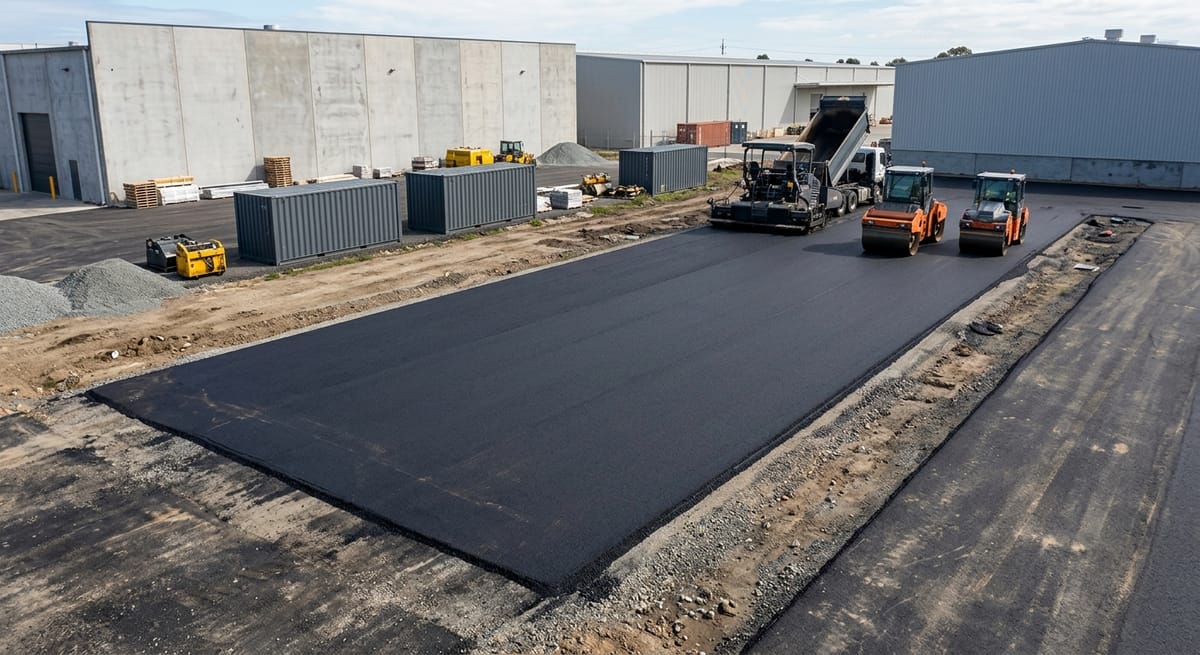
Modesto's position as a central hub for agricultural and industrial distribution means that local facilities experience relentless heavy vehicle traffic year round. The structural integrity of industrial properties relies heavily on proper warehouse yard paving. When facility managers evaluate their exterior logistics spaces, warehouse yard paving becomes a critical factor for operational safety and environmental compliance. Recently, heightened scrutiny on industrial safety and chemical runoff has changed how property owners in Modesto approach their exterior surfaces. This article examines the current regulatory climate affecting industrial sites and details the specific engineering requirements necessary for heavy duty asphalt applications. You will learn how local environmental policies impact pavement design, what materials meet California state standards for high traffic zones, and how to evaluate the current health of your facility surfaces. Beyond simple aesthetics, the condition of the asphalt directly dictates the efficiency of daily freight movements and the safety of the workers operating heavy machinery. By understanding the precise technical specifications and compliance mandates, commercial property owners can make informed decisions that protect their assets, prevent costly regulatory fines, and ensure safe daily operations for heavy freight vehicles.
CalMatters Report Sparks Scrutiny on Warehouse Safety
According to CalMatters, residents across California are demanding stricter accountability following two severe chemical emergencies that exposed significant gaps in environmental safety laws. This statewide push for industrial oversight mirrors local concerns in the Central Valley, where rapid logistics expansion has prompted intense community review. A recent Modesto warehouse project draws questions on traffic, job creation, and environmental impact, highlighting the growing pressure on developers to implement robust site management plans. Industrial fires further compound these concerns, as emergency responders struggle to contain toxic runoff. A recent 'Intense' Modesto pallet yard fire spreads to nearby structures, demonstrating how quickly hazardous conditions can escalate when warehouse yard paving is not properly engineered to contain runoff and support emergency response vehicles.
In a follow-up analysis of the CalMatters report published in early 2024, investigative journalists further detailed how these two severe chemical emergencies were directly exacerbated by failing exterior infrastructure. The publication noted that over forty percent of older industrial facilities in the state lack the proper impermeable surface grading required to contain hazardous spills effectively. Furthermore, the report highlighted that current environmental safety laws mandate strict secondary containment protocols, but these critical laws are frequently undermined when the primary warehouse yard paving is severely degraded, cracked, or improperly sloped. The data clearly shows that industrial properties with neglected pavement are disproportionately responsible for toxic groundwater contamination during emergency events.
The concrete implication of these regulatory shifts is that property owners can no longer treat aging, cracked asphalt as merely a deferred maintenance issue; it is now a direct vulnerability regarding state environmental compliance. When a chemical spill or toxic firefighting runoff occurs on compromised warehouse yard paving, the hazardous liquids bypass surface drainage systems and infiltrate directly into the soil and groundwater table. This immediate contamination triggers aggressive regulatory action from state environmental agencies. Consequently, facility managers face not only astronomical environmental remediation costs but also the potential for severe legal penalties, steep fines, and forced operational shutdowns until the site is brought into full regulatory compliance.
In the context of the Modesto warehouse project that drew intense community questions, the scrutiny extends far beyond just traffic congestion and job creation. Local residents and environmental advocacy groups are hyper-aware of the impact that 80,000-pound big rigs have on local infrastructure and the adjacent environment. When developers propose massive new logistics centers, they are now required to present comprehensive site management plans that detail exactly how their warehouse yard paving will withstand the relentless punishment of heavy freight vehicles without deteriorating into a source of fugitive dust or toxic runoff. The pavement must be engineered to act as an impenetrable barrier, protecting the underlying soil from the daily drips of diesel fuel, hydraulic fluid, and engine oil that are inevitable in high-traffic distribution hubs.
The intense Modesto pallet yard fire near Highway 99 serves as a stark, real-world example of why robust exterior paving is a critical component of emergency management. During such catastrophic events, thousands of gallons of water are deployed by the Modesto Fire Department, mixing with melted asphalt, chemical treatments from wood pallets, and industrial solvents. If the warehouse yard paving is structurally sound and properly graded, this highly toxic slurry is directed safely into designated catch basins and clarifiers, preventing widespread environmental disaster. However, if the pavement is heavily rutted, potholed, or suffering from extensive alligator cracking, the hazardous runoff pools in depressions or seeps into the earth, transforming a localized fire emergency into a long-term, multi-million dollar environmental cleanup operation that can bankrupt an unprepared property owner.
Local Impact and Environmental Regulations in Modesto
The rapid expansion of the logistics and agricultural distribution sectors in the Central Valley has placed unprecedented stress on industrial properties throughout Modesto and its surrounding suburbs. Facilities located in heavily trafficked industrial corridors such as Ceres, Salida, Riverbank, and West Modesto are experiencing accelerated pavement degradation due to the unique combination of regional operational demands and environmental factors. These areas serve as the backbone for the region's agricultural output, meaning warehouse yard paving is constantly subjected to the immense axle loads of almond huller transport trucks, dairy freight tankers, and heavy-duty forklifts. When combined with the Central Valley's extreme summer temperatures, which frequently exceed 105 degrees Fahrenheit, the asphalt binder is pushed to its absolute thermal limits, making it highly susceptible to deformation and structural failure under heavy loads.
Furthermore, the underlying soil conditions in these specific suburbs complicate the engineering requirements for warehouse yard paving. Much of the Modesto area, particularly near the Tuolumne River and in West Modesto, features a mix of sandy loam and expansive clay soils. Expansive clay is notorious for its dramatic volume changes, shrinking significantly during the arid summer months and swelling massively during heavy winter rainstorms. If the asphalt surface is not perfectly sealed, water intrusion reaches this reactive subgrade, causing the entire pavement structure to heave and collapse. Facility managers must account for these hyper-local geological conditions when designing or rehabilitating their exterior logistics spaces, as standard commercial paving specifications are entirely inadequate for this environment.
To combat the environmental fallout of degraded industrial sites, local and regional authorities have implemented stringent regulations that directly impact pavement management. For instance, the San Joaquin Valley Air Pollution Control District (SJVAPCD) actively enforces Regulation VIII, which is designed to limit fugitive dust emissions from unpaved or severely degraded traffic areas. Under this regulation, industrial facilities with crumbling asphalt that generates visible dust plumes from truck traffic can be cited and heavily fined. Additionally, the Modesto Municipal Code, specifically Title 15 regarding Buildings and Construction, outlines strict mandates for commercial grading and stormwater management. Property owners are legally obligated to maintain their exterior surfaces in a condition that prevents the pooling of stagnant water and ensures that all surface runoff is properly directed to approved municipal storm drains or on-site retention facilities. For further reading, see 401 Water Quality Certifications.
One of the most catastrophic failure modes experienced by industrial facilities in Modesto is the progression of alligator cracking leading to total subgrade failure. This failure mode begins microscopically, driven by the thermal fatigue of the extreme summer heat and the repeated, concentrated axle loads of heavy machinery. As the asphalt flexes under the weight of an 80,000-pound truck, small surface cracks form. During the winter storm season, water intrudes through these unsealed cracks, saturating the underlying Class 2 Aggregate Base. Once the base rock is saturated, it loses its load-bearing capacity and structural integrity. The next time a heavy truck drives over the saturated area, the pavement deflects deeply, causing the cracks to spiderweb and interconnect, resembling the scales of an alligator's skin. For further reading, see Worker killed in forklift accident at Modesto warehouse, ....
If left unaddressed, this alligator cracking rapidly accelerates into a complete structural collapse. The interconnected pieces of asphalt break loose and are dislodged by the turning tires of forklifts and big rigs, creating massive, deep potholes. This failure mode is not just an aesthetic issue; it presents a severe operational hazard. Deep potholes can snap the axles of expensive warehouse forklifts, cause heavy freight loads to tip and spill, and create severe trip-and-fall hazards for facility workers. Moreover, once the subgrade is exposed and compromised, the cost of repair skyrockets. Instead of a simple warehouse yard paving overlay, the facility manager is forced to fund a full-depth reclamation, requiring the complete excavation of the failed asphalt and saturated base rock, followed by the installation of a newly engineered subgrade and a thick, heavy-duty structural asphalt section. For further reading, see Hydrant washed out job site. Firm now wants $45K from ....
Technical Details of Heavy-Duty Warehouse Yard Paving
Designing and constructing warehouse yard paving that can withstand the brutal realities of industrial freight operations requires strict adherence to established engineering standards. In California, the gold standard for heavy-duty asphalt applications is the Caltrans Standard Specifications, specifically Section 39 for Asphalt Concrete. Additionally, engineers rely heavily on the Asphalt Institute Manual Series No. 4 (MS-4), which provides the definitive structural design guidelines for pavements subjected to heavy wheel loads. These standards dictate everything from the exact gradation of the aggregate rock used in the mix to the specific performance grade (PG) of the asphalt binder. For a Modesto warehouse yard, a PG 64-10 or PG 70-10 binder is typically specified to resist rutting during the scorching Central Valley summers while remaining flexible enough to prevent thermal cracking during cold winter nights.
When a heavy-duty warehouse yard paving project is underway, a qualified geotechnical engineer or public works inspector plays a critical role in ensuring the installation meets these rigorous standards. An inspector will meticulously check several key metrics during the construction process. First, they will use a nuclear density gauge to verify the compaction of the subgrade and the Class 2 Aggregate Base, strictly requiring a minimum of 95 percent relative compaction per ASTM D1557 standards. Second, the inspector will monitor the temperature of the Hot Mix Asphalt (HMA) at the time of placement; the mix must consistently arrive from the plant and be laid down at temperatures between 250°F and 300°F to ensure proper workability. Finally, the inspector will evaluate the final rolling pattern and extract core samples to verify that the finished asphalt achieves the required structural thickness and falls within the acceptable air void content range of 4 to 7 percent.
The difference between high-quality professional paving and substandard work is immediately apparent to a trained eye. There are three specific visible signs that separate good versus poor work in a warehouse yard. The first sign is the quality of the surface texture and longitudinal seams. Good work features tight, virtually invisible joints where the different passes of the paving machine meet, creating a monolithic, heavily compacted surface. Poor work, conversely, shows segregated, rocky, or open seams that lack proper compaction; these weak points will quickly unravel and allow water to penetrate the base under the stress of turning truck tires.
The second visible sign of quality is the effectiveness of the water drainage and surface grading. Good work features a precise, uniform cross-slope, typically a minimum of 1.5 to 2 percent, that ensures all rainwater flows cleanly and rapidly to the designated catch basins or bio-swales without interruption. With poor warehouse yard paving, water will pond in these depressions for days after a rainstorm, slowly seeping into the asphalt, stripping the binder from the aggregate, and accelerating the formation of potholes.
The third critical indicator is the execution of edge transitions and tie-ins. Warehouse yard paving frequently interfaces with concrete loading docks, heavy-duty concrete aprons, and municipal gutters. Good work features flush, seamlessly milled, and heavily compacted transitions that allow a forklift carrying a fragile load to pass over the joint without a single bump. Poor work leaves uneven lips, jagged edges, or crumbling transitions. These substandard edges not only create severe jarring impacts for heavy equipment operators but also tend to break off in large chunks under the immense pressure of solid forklift tires, leading to rapid edge failure.
Unfortunately, unqualified contractors frequently make critical installation mistakes that doom the pavement to premature failure. One of the most common mistakes is inadequate subgrade preparation. Failing to perform a loaded proof-roll to identify yielding soils, or neglecting to over-excavate and replace saturated clay with engineered fill, leaves the pavement without a solid foundation. The consequence is devastating: the entire pavement structure settles unevenly, causing massive, structural rutting directly under the wheel paths of heavy trucks within the first year of operation, rendering the yard unsafe for high-speed logistics.
Another frequent and costly mistake is cold paving. This occurs when a contractor attempts to lay asphalt when the ambient weather conditions are too cold, or when they allow the mix to sit in the delivery trucks for too long, causing the temperature to drop below the critical threshold. The consequence of cold paving is that the heavy vibratory rollers cannot achieve the required compaction density before the asphalt stiffens. This leaves the pavement with excessively high air voids, making it highly porous. Water rapidly infiltrates the surface, leading to premature oxidation, severe raveling of the surface aggregate, and a drastically reduced lifespan.
Finally, the most egregious mistake made in industrial applications is designing with insufficient pavement thickness. Contractors accustomed to paving residential driveways or light-duty retail parking lots will often specify a standard 3-inch asphalt section over a minimal base rock layer. When this light-duty specification is applied to warehouse yard paving that processes fully loaded 18-wheelers, the consequence is immediate fatigue failure. The thin asphalt simply cannot distribute the immense axle loads, resulting in instant alligator cracking and the need for a complete, multi-million dollar full-depth reconstruction long before the pavement reaches its expected 20-year design life.
Action Steps for Facility Managers Evaluating Pavement
The first critical action step for facility managers is to conduct a comprehensive visual inspection and meticulously document the current state of the pavement with high-resolution photography. You should take detailed macro shots of specific distresses, such as the width of surface cracks, and wide-angle shots that capture the extent of ponding water or structural rutting across your warehouse yard paving. It is highly recommended to place a standard tape measure or a recognizable object next to the damage in the photographs to provide an accurate scale of the deterioration. Furthermore, you must document the exact location of these distressed areas on a master site map, which will be invaluable when communicating the scope of work to engineers and paving contractors.
The second step involves a thorough review of your facility's drainage systems and overall stormwater compliance standing. You must physically inspect all surface catch basins, trench drains, and clarifiers to ensure they are free of sediment buildup, debris, and blockages that could cause water to back up onto the asphalt. Crucially, you need to cross-reference the current condition of your pavement and drainage infrastructure with the facility's active Storm Water Pollution Prevention Plan (SWPPP). Under the California Industrial General Permit, failing to maintain an impermeable, properly draining surface that prevents pollutants from contacting stormwater can result in severe fines, making this review a mandatory compliance check.
Third, before soliciting bids for major repairs, it is imperative to engage a licensed geotechnical engineer to perform a structural assessment of the underlying foundation. The engineer will drill soil borings and extract full-depth asphalt core samples from various locations across the warehouse yard paving. These physical samples allow the engineer to determine the exact thickness of the existing asphalt, the depth and condition of the Class 2 Aggregate Base, and identify any hidden subgrade deficiencies, such as expansive clay or high moisture content. This scientific data is absolutely necessary to engineer a custom pavement design that will permanently solve the root cause of the failure, rather than just temporarily covering it up.
Fourth, facility managers must proactively navigate the local authority permitting process well in advance of the planned construction schedule. You will need to contact the City of Modesto Community and Economic Development Department to determine the specific regulatory requirements for your warehouse yard paving project. Depending on the scope of the excavation and grading, you will likely need to submit detailed engineering plans to secure a formal Grading Permit or an Encroachment Permit if the work interfaces with public right-of-ways. Facility managers must factor in typical municipal processing times, which generally range from 4 to 6 weeks for commercial grading plan reviews, to avoid costly delays in the project timeline.
Fifth, when the time comes to select a partner for the project, you must implement a rigorous vetting process for potential paving contractors. It is not enough to hire a company that does excellent work on residential driveways or light commercial retail lots; you must demand references specifically for heavy-duty industrial warehouse yard paving. You should physically visit these reference sites to inspect how their asphalt has held up after several years of abuse from 80,000-pound big rigs and solid-tire forklifts. A qualified industrial contractor will deeply understand high-load structural requirements, advanced compaction techniques, and the logistical complexities of phasing construction to keep your facility operational.
Finally, before any heavy equipment arrives on your property, you must execute a strict insurance and liability verification process with your chosen contractor. You must ask highly specific insurance questions and demand official certificates of coverage directly from their broker. Specifically, ask: "Does your General Liability policy include explicit coverage for underground utility damage during deep excavation?" and "Is your Workers' Compensation policy fully active and properly coded for all heavy equipment operators working on an industrial site?" Verifying these exact coverages protects your company from catastrophic financial liability in the event of an accidental utility strike or a severe worker injury on your property.
The Value of Professional Paving Contractors
In the high-stakes environment of industrial logistics, the value of hiring a truly professional, specialized paving contractor cannot be overstated. Warehouse yard paving is not a cosmetic upgrade; it is the construction of a critical structural asset that directly impacts the safety of your workforce, the efficiency of your freight operations, and your compliance with strict environmental regulations. Attempting to cut costs by hiring unverified, cut-rate crews inevitably leads to catastrophic pavement failures, operational downtime, and repair costs that dwarf the initial savings. A professional contractor brings the necessary heavy-duty equipment, the specialized engineering knowledge, and the highly trained personnel required to execute complex structural paving correctly the first time.
In the State of California, the law is explicitly clear regarding who is legally permitted to perform this type of heavy civil construction. To legally contract for warehouse yard paving in Modesto, a company must hold a valid, active C-12 Earthwork and Paving Contractor license, or an A - General Engineering Contractor license, issued directly by the California Contractors State License Board (CSLB). This specific license guarantees that the contractor has passed rigorous trade examinations, undergone state and federal background checks, and possesses the mandatory minimum years of verifiable journeyman-level experience in heavy structural paving. Facility managers must independently verify the status of this license on the CSLB website before signing any contracts.
The penalties for engaging in unlicensed contracting, or hiring an unlicensed entity for warehouse yard paving, are severe under California law. According to the California Business and Professions Code Section 7028, it is a misdemeanor to act in the capacity of a contractor without a valid CSLB license. The penalty for a first offense includes up to six months in county jail and a criminal fine of up to $5,000. Furthermore, the CSLB can levy mandatory administrative fines ranging from $200 to $15,000 against the unlicensed individual. For a facility manager or commercial property owner, knowingly hiring an unlicensed contractor exposes the corporation to immense legal scrutiny and potential complicity in violating state labor and business codes.
Beyond the criminal penalties, the insurance and warranty implications of using unlicensed or unqualified labor are financially devastating. If a facility manager hires an unlicensed contractor and a pavement-related accident occurs, such as a forklift tipping over due to a collapsed subgrade, or a toxic chemical spill resulting from improper drainage, the commercial property insurance provider will almost certainly void the claim, leaving the property owner entirely responsible for all damages and environmental remediation costs. Furthermore, legitimate material manufacturers, such as the local asphalt batch plants that supply the Hot Mix Asphalt, will explicitly void all material performance warranties if the product is not installed by a CSLB-licensed professional, leaving you with zero recourse when the warehouse yard paving prematurely fails.
Frequently Asked Questions
What is the minimum recommended asphalt thickness for a warehouse yard in Modesto?
For heavy-duty warehouse yard paving in Modesto that regularly processes 80,000-pound 18-wheelers and heavy forklifts, a standard commercial thickness is entirely inadequate. Geotechnical engineers typically recommend a minimum structural asphalt thickness of 4 to 6 inches, placed in multiple compacted lifts. This thick asphalt layer must be supported by a robust foundation, usually consisting of 8 to 12 inches of highly compacted Class 2 Aggregate Base. The exact specifications, however, must be determined by a site-specific soil analysis, as the presence of expansive clay or poor-draining sandy loam in the Central Valley will dictate the final engineered pavement section required to prevent fatigue failure.
How does the extreme Central Valley summer heat affect industrial asphalt?
The extreme summer heat in the Central Valley, which frequently exceeds 100°F, has a profound impact on industrial asphalt. Asphalt is a viscoelastic material, meaning it becomes softer and more pliable as temperatures rise. Under the intense heat, the asphalt binder can become susceptible to severe deformation, rutting, and shoving when subjected to the heavy, concentrated wheel loads of turning big rigs and forklifts. To combat this, professional paving contractors utilize specific Performance Graded (PG) binders, such as PG 64-10 or PG 70-10, which are chemically engineered to remain stiff and resist rutting at high temperatures while maintaining enough flexibility to prevent cracking during colder winter months.
Why is my warehouse yard asphalt developing alligator cracks?
Alligator cracking, characterized by a series of interconnected cracks resembling reptile skin, is the primary indicator of structural fatigue and subgrade failure. In warehouse yard paving, this typically occurs when the pavement thickness is insufficient to handle the repeated heavy axle loads of freight vehicles, or when water has successfully infiltrated the surface and saturated the underlying aggregate base. Once the base rock is saturated, it loses its load-bearing strength, causing the asphalt surface to deflect deeply under the weight of a truck. This repeated bending causes the asphalt to fracture. The only permanent solution for extensive alligator cracking is full-depth reclamation and reconstruction.
Do I need a permit from the City of Modesto to repave my industrial yard?
Yes, in almost all cases involving commercial and industrial properties, significant paving work requires municipal oversight. If you are performing a simple surface overlay with no changes to the existing drainage patterns, the requirements may be minimal. However, if your project involves excavation, altering the subgrade, changing the slope, or modifying how stormwater runoff connects to the municipal system, you will absolutely need to secure a Grading Permit from the City of Modesto Community and Economic Development Department. Additionally, if your paving work interfaces with public sidewalks or streets, an Encroachment Permit is mandatory before any construction begins.
How long should a newly paved warehouse yard last before needing replacement?
When properly engineered, installed by a CSLB-licensed contractor, and subjected to a rigorous preventative maintenance program, newly installed heavy-duty warehouse yard paving should have a structural lifespan of 15 to 20 years. However, achieving this lifespan requires proactive management. Facility managers must commit to routine maintenance, including professional crack sealing every year to prevent water intrusion, and the application of high-quality commercial sealcoating every 3 to 5 years to protect the asphalt binder from oxidation, UV damage, and chemical spills. Neglecting these basic maintenance steps can cut the pavement's lifespan in half, resulting in premature structural failure.
Conclusion
Maintaining the structural integrity of warehouse yard paving is not merely a matter of property aesthetics; it is a fundamental requirement for operational safety, logistical efficiency, and strict environmental compliance in Modesto. As regulatory agencies intensify their scrutiny on industrial facilities to prevent toxic runoff and chemical contamination, property owners can no longer afford to ignore degrading exterior infrastructure. The unique combination of heavy agricultural freight traffic, extreme Central Valley temperatures, and challenging local soil conditions demands a highly engineered approach to pavement design and maintenance.
By understanding the critical technical specifications, recognizing the early warning signs of pavement failure, and strictly adhering to local permitting and environmental regulations, facility managers can protect their substantial real estate investments. Most importantly, partnering exclusively with fully licensed, heavily insured, and experienced professional paving contractors ensures that your warehouse yard paving will withstand the brutal demands of daily freight operations. Taking proactive, informed action today will prevent catastrophic structural failures, shield your corporation from severe regulatory fines, and guarantee a safe, highly efficient environment for your heavy machinery and workforce for decades to come.